Melissa Denby


IDEO U's AI + Design Thinking course
This is a case study I wrote showcasing my project during this seven week course. I already had years of experience working within Enterprise Design Thinking, but took this to specifically learn how to use AI as part of my design process.

The challenge
Helping the older population access their medical information, that needs to be repeatedly entered at their doctors' visits, so that they have a smoother experience with accurate information.
Going to the doctor can be a stressful experience, or sometimes a necessary chore, but something that we all do to take care of our health. I've gone to the doctor--well, many doctors, frequently--due to breast cancer. And while the doctors, nurses, and staff were all kind and excellent people, the process of filling out the forms was frustrating. I'm sure I can't be the only person that had this experience. And I noticed that even after cancer, well the forms were still there and asking for a lot of the same repeated information--primary, Radiology--go get your mammograms!--surgeons etc. I had to keep looking up my history, answering the same questions, and finding my primary doctor's phone number. My mom is a nurse practitioner, so she sees the other side. She's a provider trying to help patients, educate them, and comfort them. From her stories, they don't always know their history, or remember what medication they take. So bring in bags of medicine, others describe "a round, blue pill". Others rely on caregivers. I know this takes a lot of time for her to confirm because she needs accurate information, and not having that has real consequences. All of this got me thinking--it'd be useful to have this information, correct information--at the ready so patients don't have to look it up repeatedly, and as a bonus their caretakers, spouses, children have access to it too. And the providers also have the right information.
User research
The next step was to do research, with real people. And talking to them changed my assumptions, and made me think more deeply about the problem.
So I decided to do some research and talk to people. Of course I talked to friends around my age, who gave me such great feedback. They wanted to have access to their own information, and were also thinking about their aging parents. I knew I was on the right track...That is until I talked to a group of five women who live in a retirement community and go to Harris Teeter to listen to live music with their friends on Thursdays. These ladies were smart, funny, and forthcoming. And they honestly ruined my assumptions--but in the best way. They are the users, they are my persona. What I learned from them is that: • They're not tech savvy • They fill out forms on MyChart before the appointments • They are fine with MyChart • Not concerned with their family history because they know it • They keep a piece of paper with their medication list in their purse • They don't like to fill out a lot of forms • "I feel like we're doing the work for them" • Not worried about other friends or spouses


What I learned
I learned more about my users, and what they wanted, how they navigated their doctors' appointments, and things that would work best for them.
So my dream of an app was dead before I even started lol. They weren't concerned about what I assumed, but those friends in my demographic were. Whatever solution I explored needed to meet their needs and meet them where they are, which is in MyChart. Several ideas came to the top: maybe a form with prefilled information that could be confirmed, not re-entered, maybe a printout that the doctor hands the patient with their updated medication at the end of each visit. And then I had more questions: Was the reason patients needed to fill out the forms repeatedly a way to have them engage and not be complacent with their medical information? Also, if a patient fills out a paper form, an office worker needs to enter it, potentially creating another point for misinformation. I started looking though MyChart to find information, and see what information I was asked for in each place. Turns out there's a lot of information on MyChart--the sharing, the doctor's information, and in fact each visit summary. Unfortunately, I had to Google to find a summary of my own information. It was a lot of great information but at least for me, it felt challenging to access. Then after a classmate said she'd had similar experiences, filling out a form about a Pap Smear when she'd had a hysterectomy years before, the frustration felt real. Using AI as a synthesis partner, I landed on a conclusion that reframed the whole challenge: patients want to feel seen as humans during a doctor's visit. They don't want to enter known information again.
Insights
The main thing I learned was that people want to be seen as humans, as people.
And who doesn't want to be seen? No one likes being rushed, searching for information that should be there already. No one wants to go to the doctor, and from my Mom's stories, as a provider, they don't want to rush either, but are expected to do a lot in a small amount of time. In short no one really wants to be there but it's important right? It's hard not to have empathy for my Harris Teeter ladies. Their focus is enjoying their lives, enjoying the music and conversation at Harris Teeter. For me personally I don't like having to check a box on a form for Radiology every year that I've had a mastectomy so they can't image both breasts. Though I see my friends, classmate, and the providers view too. Worrying about future health things, worrying about going with their parents. However, for this first iteration and exploration I'm focusing on helping my Harris Teeter ladies. Helping them navigate MyChart to find their information or perhaps getting their information on paper more easily. Though I see my friends, classmate, and the providers view too. Worrying about future health things, worrying about going with their parents to appointments, not knowing their history. Everyone in this picture deserves a smoother experience.


The first iteration
After many ideations, I created my first iteration – wireframes that addressed the online experience and also incorporated the"paper" experience.
I created an empathy map so I could consolidate my interviews into one persona, Margaret, that represented the ladies I spoke with at Harris Teeter. Then I took all of the insights, and began to think of ideations that would improve their experience. Several ideas stood out and I used AI for further exploration and feedback on my ideas. The one thing that continued to stand out was that patients felt unseen. Margaret, our patient persona, is smart, capable, and has agency--she is an active participant in her own healthcare, however she also feels that it's necessary to keep a paper version in her purse of her medications for each doctor's appointment. My first iteration addresses two scenarios: Margaret checking in online for her appointment. And being able to print her medication list. (This pattern can be applied to other areas) Margaret independently looking at her medications. (This pattern can also be applied within the same flows.) Though on a more thoughtful note, I feel like there are still some outstanding questions that can only be answered with more research, understanding, and learning more about MyChart from the inside. For example: On the form validation vs. complacency tension: The question of whether re-entering information forces patients to actively engage versus just creates burden and errors is a real clinical and design tension. And the staff transcription point — patient fills out paper, office worker re-enters it — adds a second point of potential error that a better system could eliminate entirely. Personas: The HT ladies are just one persona, and some of the questions and ideas I've had may address problems for other personas. Younger adults, or caregivers. The MyChart complexity: The data is in MyChart, but there are problems in its organization and access.
I created to user flows for Margaret, the first to address her checking in for a specific doctor's appointment, and the second showing if she were to review and update her medications. The patterns are intentionally the same, and could be expanded to be used for family history, or updating surgeries.
Use case number one
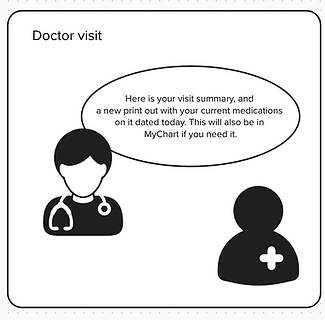
Margaret is checking in for an upcoming doctor's appointment, is asked to verify her medications. She has the option to remove, update, or add medications as before, however this time she has the option to print her medication list. She can also notify or update other providers of her medication changes. At the end of her check-in she can also print a summary for her visit. Finally, after her visit a new updated list of medications will be given to her, building trust in her doctor, relief that she has the correct information, and later she's able to confirm that MyChart is also accurate.


Use case number two
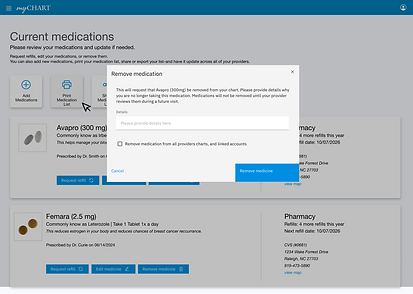
Margaret is updating her MyChart medications and checking to make sure her information is correct across all of her doctors. Again she has the option to update, delete, or add. Following the same pattern, she has the option to print her medication list so she has an accurate copy in her purse.


The final iteration
This is a more polished version of the previous prototype after getting more feedback. And reflecting about future thoughts and iterations based on what I learned during this project.
I created a more polished version of the prototype using the Carbon Design System, (since that's the design system that I'm most familiar with) and though I imagine Epic has a design system, it was unclear which one. These screens follow the same two flows but are higher fidelity, mid-fi designs, simply because there's more to learn from users, and providers. As part of validating my designs, I spoke with my mom, a retired nurse practitioner, to resolve some of my questions. I wasn't able to understand why patients have to fill out previously known information, instead of confirming it. But I was able to confirm that the medication information on my designs would actually be helpful for providers too. Based on her recommendation, I added the medication number for the provider so they can check the medications for accuracy. She also really liked the image of the pills, and the explanation for the patient about 'why' they take this specific medicine because that would help not only the patient, but the caretaker, and provider. However, as a conclusion to this project, one of the main take-aways I had was that this Problem resonated with a lot of people--not only the older people, but also people from their 20s through 50s, providers, caretakers, and spouses. I believe this area is rich for more exploration and as a UX designer I believe there's always something new to learn, and more design iterations to create.
Use case number one




Use case number two


